- 44% of patient-facing NHS staff say patients raise inaccurate or misleading nutrition or supplement information at least once a week
- People who rely on social media for news more likely to believe false or misleading claims about cancer and nutrition
- World Cancer Research Fund launches TRUST Test and calls for stronger support for evidence-based advice through the NHS Workforce Plan
Nearly half of patient-facing NHS staff (44%) say patients bring them inaccurate or misleading nutrition or supplement information at least once a week, according to new analysis from World Cancer Research Fund.
The charity’s research also reveals a growing mismatch between confidence and understanding among the public, with people who rely on social media for news more likely to feel confident about finding trustworthy nutrition information online, while also being more likely overall to believe misleading claims about diet, supplements and cancer prevention.
World Cancer Research Fund says the findings highlight the current pressure on healthcare professionals, while confusion online is making it harder for people to make informed choices about their health.
In response, the charity is calling on the UK Government to use the NHS Workforce Plan to strengthen support for evidence-based advice on cancer prevention, nutrition and physical activity. It is also launching a simple new TRUST Test to help the public and healthcare professionals spot health misinformation online.
Despite healthcare professionals being the public’s most trusted source of nutrition advice, World Cancer Research Fund’s analysis shows many staff are under strain from the volume and complexity of misinformation:
- 44% of patient-facing NHS staff say patients raise inaccurate or misleading nutrition or supplement information at least once a week, including 6% who say this happens daily or almost daily
- 40% say they are not confident that nutritional advice they see online is correct
- 37% of healthcare professionals say they are not confident about where to find reliable, evidence-based information on supplements
World Cancer Research Fund is already working to support healthcare professionals and the public through its Cancer and Nutrition Helpline, webinars, workshops, cooking through cancer classes and practical resources designed to improve understanding of nutrition and cancer prevention. However, the charity warns that while these initiatives are helping, they cannot keep pace with the scale of misinformation people are encountering online.
The charity’s wider public polling also highlights a growing confidence gap in how people navigate health information.
While 62% of UK adults say they feel confident they can find trustworthy nutrition information online, this rises to 72% among those whose main news source is social network websites.
This same group is more likely to hold inaccurate beliefs about cancer prevention and nutrition. Compared with those whose main news source is not social media, they are:
- less likely to identify eating plenty of fibre as something that can reduce cancer risk (48% vs 55%)
- more likely to think certain supplements can reduce cancer risk (15% vs 11%)
- more likely to think certain foods or diets can “starve” cancer (13% vs 7%)
More broadly, misleading nutrition narratives appear to be shaping everyday health beliefs:
- 1 in 5 people (20%) say detoxes or “cleanses” are good for health
- 11% of 18-34s wrongly think eating the same ‘superfood’ most days can reduce cancer risk,
- more than 1 in 5 (21%) spend over £10 a month on dietary supplements
World Cancer Research Fund warns this matters because misleading information can divert people away from the everyday habits known to reduce cancer risk – at a time when around 4 in 10 cancer cases in the UK are preventable.
Previous UK research had found that in the UK more than 70% of medical students and doctors surveyed reported receiving fewer than two hours of nutrition training at medical school**.
The charity says more can be done to support the next generation of healthcare professionals. It is already working with medical schools at the Universities of Lincoln and Southampton to create practical teaching resources for tomorrow’s doctors on diet, weight and cancer risk, while its pilot scheme with NHS Greater Glasgow and Clyde makes the charity’s Cancer and Nutrition Helpline part of many patient’s cancer care pathways.
Launching Cancer Prevention Action Week’s Science Not Fiction 3-year Campaign (15–21 June), World Cancer Research Fund says the NHS Workforce Plan presents a critical opportunity to better equip healthcare professionals. This includes improving access to training on nutrition, physical activity and reducing alcohol consumption in relation to cancer prevention and survivorship, alongside high-quality, evidence-based resources developed with cancer charities.
This is not about expecting healthcare staff to act as dietitians or become misinformation experts but to have clear, trusted information to support them in these circumstances, to help them respond confidently when patients raise questions about claims they’ve seen online.
World Cancer Research Fund’s UK Director, Steven Greenberg, said:
“Misinformation about diet and cancer isn’t just confusing, it’s putting people’s health at risk. The danger isn’t just false claims, it’s advice that’s distorted, taken out of context, or presented in a way that hides the risks.
“We know people are acting on this information, particularly when it comes from social media, and that can have real consequences for their health.”
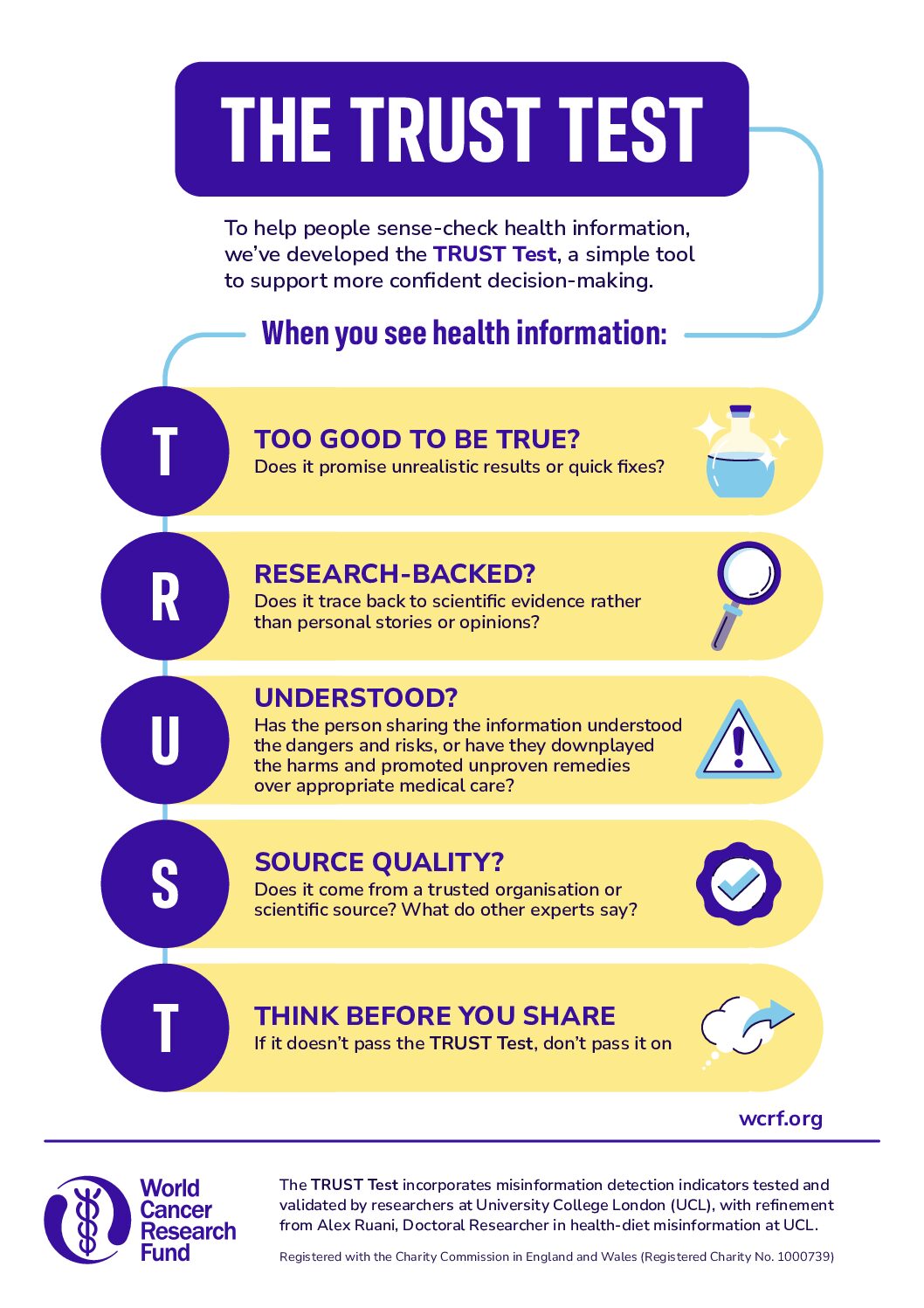
TRUST Test
World Cancer Research Fund has developed a simple, science-based memory tool to help both the public and healthcare professionals navigate misinformation, which the charity hopes will help reduce time spent tackling misleading claims in consultations so healthcare professionals can focus on core patient needs:
T — Too good to be true?
Does it promise unrealistic results or quick fixes?
R — Research-backed?
Does it trace back to scientific evidence rather than personal stories or opinions?
U — Understood?
Has the person sharing the information understood the dangers and risks, or have they downplayed the harms and promoted unproven remedies over appropriate medical care?
S — Source quality?
Does it come from a trusted organisation or scientific source? What do other experts say?
T — Think before you share
If it doesn’t pass the TRUST Test, don’t pass it on
The TRUST Test incorporates misinformation detection indicators tested and validated by researchers at University College London (UCL), with refinement from Alex Ruani, Doctoral Researcher in health-diet misinformation at University College London. In YouGov’s qualitative testing for WCRF, participants described the TRUST Test as clear, memorable and practical. It goes live on 15 June at https://www.wcrf.org/trust-test
World Cancer Research Fund’s Chief Executive, Rachael Hutson, said:
“Too many people are trying to make important health decisions in a fog of online misinformation.
“When advice is confusing or misleading, it can take people away from the everyday habits we know help reduce cancer risk and towards claims that are exaggerated, distorted or simply untrue.
“Our TRUST Test is there to help people feel more confident about what they see online because when it comes to cancer prevention, it should be based on science, not fiction.”
Alex Ruani, who has been advising World Cancer Research Fund on their misinformation campaign, said:
“We now have strong evidence that nutrition misinformation is not just misleading – it can be actively harmful. UCL research shows that inaccurate or incomplete health advice can influence real-world decisions, from dangerous dieting and supplement misuse to delaying or abandoning effective treatment.
“What makes this particularly concerning is that misinformation often presents itself with confidence and simplicity, while leaving out crucial context, risks or uncertainty. That combination makes it more persuasive, especially on social media where engagement is driven by emotionally compelling claims rather than careful evidence.
“If we want to reduce harm, we need to start treating exposure to misleading health information as a public health risk in its own right – something we can measure, prioritise and act on. Tools like the TRUST Test are important because they help people recognise these patterns and make decisions based on verifiable evidence, not just what sounds convincing.”
Former breast surgeon, three-time breast cancer patient, keynote speaker and author Liz O’Riordan, who is supporting World Cancer Research Fund’s campaign, said:
“As a breast surgeon and breast cancer patient, I know how overwhelming it can be trying to make sense of all the information out there.
“When something sounds hopeful, it’s very easy to think ‘why not try it too?’ even if it’s not based on solid evidence. A lot of this information sounds convincing, but it doesn’t always tell the full story – and that can make an already difficult situation even harder and at times dangerous.”